You've found a lovely hotel. The swimming pools look fantastic, there's plenty for the children to do, and the beach is just a short walk away.
Everything seems perfect.
Then you get to the accommodation details.
Family Room: Sleeps Four.
Brilliant. That's two adults and two children sorted, isn't it?
Well, not necessarily.
Because there's quite a difference between a hotel room that can accommodate four people and one where four people can comfortably spend a week together.
And sometimes, it's the little details that make the biggest difference to your holiday.
What happens when the children go to bed?
Here's where I'd start.
Imagine you've spent the day swimming, exploring or enjoying the hotel.
The children are tired and ready for bed.
But you're not.
Perhaps you'd like to watch something on television, sit down with a drink or simply have a conversation without whispering.
Now imagine everybody is sleeping in the same room.
Suddenly, your evening entertainment consists of sitting in the bathroom trying not to make any noise.
Not quite the relaxing holiday you'd pictured!
Of course, some families are perfectly happy sharing one sleeping space, particularly with younger children.
Others might benefit from a partition, a separate sleeping area or a bedroom with an actual door that closes.
And that distinction is important.
A family suite doesn't automatically mean separate bedrooms. Some suites have an open-plan living and sleeping area, while others offer a proper division.
I'd rather understand the layout before recommending the room than discover the difference after you've arrived.
What is everybody actually sleeping on?
Another thing worth considering is the sleeping arrangement itself.
When a hotel advertises a room for four people, that doesn't necessarily mean four ordinary beds.
You might have a double bed and two singles.
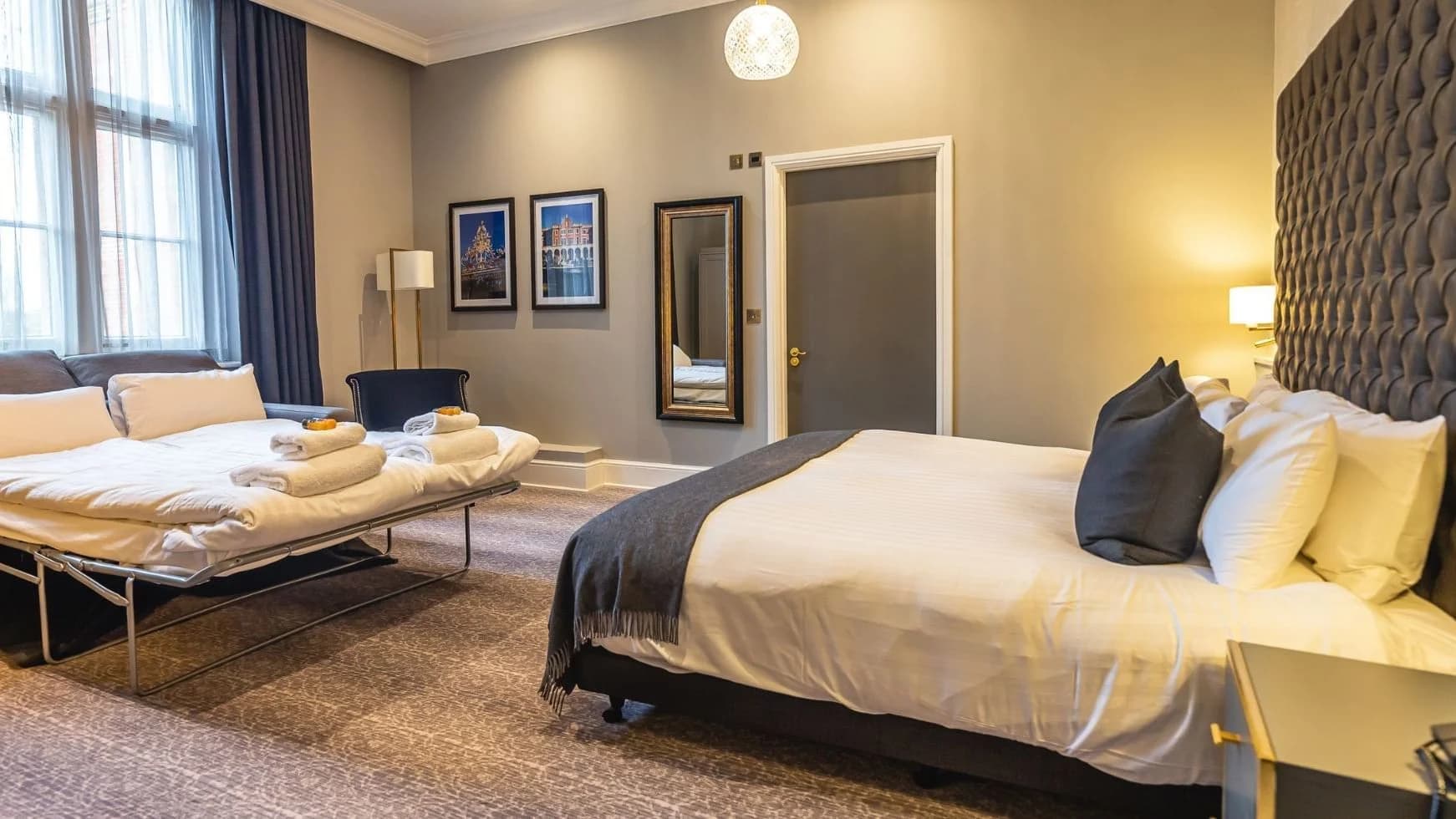
Or perhaps a double bed and a sofa bed.
There could be bunk beds, folding beds or additional sleeping arrangements that are only suitable for younger children.
And if you're travelling with teenagers, those differences can matter enormously.
A sofa bed that works perfectly well for a six-year-old might be rather less appealing to a teenager who's almost six feet tall.
Then there's the question of sharing.
Some siblings are perfectly happy sleeping together.
Others would consider sharing a duvet an unacceptable violation of their human rights.
So when I'm looking at accommodation, I'd want to understand who is sleeping where, rather than relying on the fact that the booking system accepts four names.
And children's ages at the time of travel matter, because hotels can have different arrangements and occupancy rules depending on who's staying.
Separate bedrooms, connecting rooms and adjoining rooms
This is another area where hotel descriptions can be confusing.
You might come across phrases such as interconnecting rooms, adjoining rooms and family suites.
They sound similar, but they're not necessarily offering the same thing.
Interconnecting rooms normally have an internal door between two rooms, allowing you to move from one to the other without entering the corridor.
Adjoining rooms are generally next to one another, but they don't necessarily have a connecting door.
And a family suite could have anything from a partially separated sleeping area to one or more distinct bedrooms, depending on the property.
For some families, connecting rooms are a brilliant option.
You get extra space, potentially another bathroom and some privacy in the evenings.
But it's important to establish whether that arrangement is actually confirmed for your booking or simply something you've requested.
If your family needs an internal connecting door, that's not a detail I'd want left to chance.
What about the space during the day?
A family hotel room has to do considerably more than provide somewhere to sleep.
Think about everything that happens during a typical holiday.
You've got suitcases, clothes, swimming costumes drying, shoes scattered around and somebody inevitably asking where their charger has disappeared to.
Now add four people getting ready for dinner at roughly the same time.
Suddenly, the size and layout of the room become rather important.
One thing I'd look at is what happens when any additional beds are opened.
Does the sofa bed take up most of the living area?
Can everyone still move comfortably around the room?
Is there somewhere to sit, or does the room essentially become one enormous sleeping area?
And if you're travelling with a baby, where would the cot go?
A lovely balcony or sea view can be a real bonus, but neither makes up for an arrangement that doesn't work for your family.
Would an apartment make more sense?
Sometimes the answer isn't finding a bigger hotel room.
It might be choosing a different type of accommodation altogether.
A one-bedroom apartment, for example, could give you separate sleeping space, a living area and somewhere to prepare simple food.
For families with younger children, that can make evenings considerably easier.
You can put the children to bed and still enjoy a little time together without having to sit in darkness.
Although I'd check the actual apartment layout before making promises.
Not every apartment has a separate lounge, and not every kitchenette is equipped for preparing proper meals.
Some provide little more than the basics, while others offer a full kitchen.
The right choice depends on how you'd use the space.
If you enjoy eating out every evening, you might not care about cooking facilities.
But if being able to prepare breakfast, snacks or familiar food for the children would help, an apartment could be worth considering.
Don't let the hotel photographs fool you
Now, I love looking through hotel photographs when researching holidays.
They can tell you a lot about the property, the facilities and the atmosphere.
But there's something important to remember.
The photograph you're looking at might not show the room you're actually booking.
A hotel could have ten different accommodation categories, from basic double rooms to spectacular suites.
Naturally, the most impressive ones tend to look rather lovely in the photographs.
That doesn't mean your particular room will have the same layout, view or facilities.
So I'd want to match the accommodation description and, where possible, the photographs to the exact room category in your quote.
If the separate bedroom is the reason you're choosing a particular room, we need to know it's actually included.
The same applies to bed arrangements, balconies, bathrooms and anything else that matters to you.
A photograph is helpful.
A confirmed room description is considerably more useful.
Is the upgrade actually worth the money?
Here's another decision families often face.
You've found a hotel you like, but there are several room options at different prices.
Perhaps the standard family room is £300 cheaper than a suite.
Or maybe the sea-view upgrade looks tempting.
Which is worth choosing?
My approach would be to think about what will genuinely improve your holiday.
If everybody sleeps happily in one room and you're rarely there during the day, the standard accommodation might be perfectly fine.
But if the children go to bed early and you'd love somewhere separate to relax, paying more for a better layout could be money well spent.
Equally, if the only difference is a slightly better view that you don't particularly care about, perhaps that money would be better used elsewhere.
I'd separate the decisions into three groups:
Essential: Things the room absolutely must have for your family.
Worth paying extra for: Features that would make the holiday noticeably more comfortable.
Nice to have: Things you'd enjoy but could happily manage without.
That makes it much easier to understand whether an upgrade represents genuine value.
Because expensive doesn't automatically mean better.
It only means better if you're getting something that matters to you.
Tell me how your family actually holidays
One of the things I want Planned by Jay to do differently is look beyond the standard hotel filters.
Of course, we need to know how many adults and children are travelling.
But I'd also love to know the practical details that make a difference.
Perhaps your children need separate beds.
Maybe you'd love a bedroom with a closing door, so the adults can still enjoy the evening.
You might need room for a cot, somewhere to prepare breakfast or enough space for everyone to get ready without queuing outside the bathroom.
And there's absolutely nothing wrong with saying that two bathrooms would make the entire holiday considerably more peaceful!
You don't need to know the official accommodation terminology.
Just tell me what works for your family, and I'll help investigate the options.
Because a family holiday should be about enjoying time together, not discovering how many people can squeeze around one open sofa bed.
Let's plan your family holiday